
Burst and frozen pipe water damage in Nashville, TN
Burst pipe water damage in Nashville usually starts with a frozen line that splits in the crawl space or an outside wall during a hard freeze, then floods once it thaws. Close the house valve, let pressure out at a faucet on the bottom floor, then dry: water extracted, soaked insulation and drywall removed where needed, and equipment running until every material reads dry.
Your call is connected with an independent local company that serves Nashville. Water category: category 1 (clean water) when caught quickly.
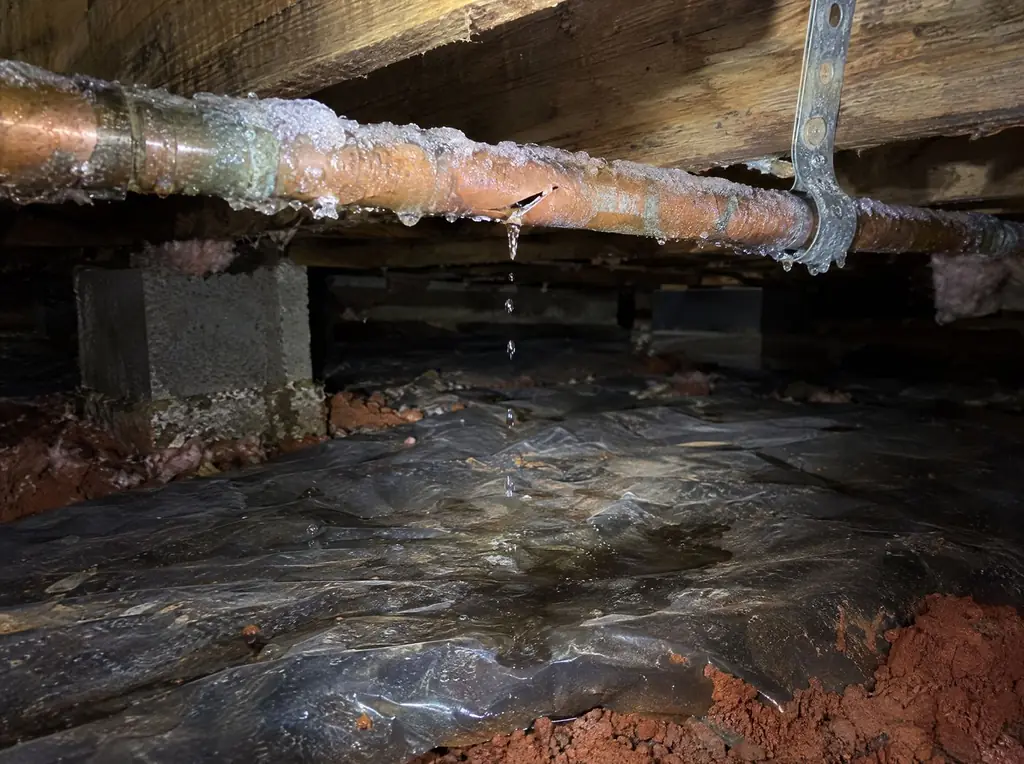
IBHS research cited by the International Code Council puts the start of freezing in unprotected pipes at 20°F outside. Nashville gets nights that cold in most winters. On one, open the sink cabinets on outside walls, let those faucets drip and close the crawl space vents; the weather page on this site flags those nights in advance.
Right now
- 1Close the house shutoff valve. If it won't turn, the valve in the meter box at the street can stop the flow.
- 2With the valve shut, run a downstairs tap until the pipes stop pushing water.
- 3If water is coming through a ceiling near a light fixture, stay out of that room and switch off its breaker only from a dry floor.
- 4Turn off the water heater's power or gas if its supply line is the one that broke.
- 5Photograph the split pipe and every wet room for your own records.
Nashville facts for this problem
Unprotected pipes begin to freeze when the outdoor temperature drops to 20°F, according to IBHS research cited by the International Code Council.
Source: ICC eNews (2014), citing IBHS research on when pipes freeze.
Over the last 30 winters, Nashville's climate record averaged 13 nights a winter at or below 20°F, and 30 of those 30 winters had at least one.
Source: ACIS daily record, Nashville area climate record, calculated by Nashville Water Damage & Mold on November 18, 2026.
Last winter (2025-26) had 13 nights at or below 20°F in the Nashville record, and the coldest reached 8°F.
Source: ACIS daily record, Nashville area climate record, calculated by Nashville Water Damage & Mold on November 18, 2026.
On the morning of Dec. 23, 2022, NWS Nashville collected readings of -5°F in Belle Meade and west Nashville and -2°F at John Tune Airport.
Source: NWS Nashville: December 22-27, 2022 Arctic Cold Wave.
Under Metro Code 15.16.200, Metro Water Services owns the water meter, the meter box and the fittings inside it; the line from the box to the house is the owner's.
Metro Water Services' customer and emergency number is 615-862-4600.
Source: Metro Water Services: sewer service line policy brochure (updated July 2015).
Among the Nashville ZIPs on this site, 37216 has the oldest median year built, 1960, and 37228 the newest, 2014 (Census ACS 5-year).
Source: U.S. Census Bureau, ACS 5-year, tables B25034 and B25035, calculated by Nashville Water Damage & Mold on November 14, 2026.
Under Metro Code 15.16.200, Metro Water Services owns the water meter, the meter box and the fittings inside it. The line from the box to the house belongs to the property owner, so a split on that stretch is a plumber's repair at the owner's cost. Metro's customer and emergency number is 615-862-4600.
Sources: Metro Council Ordinance BL2012-333 (Metro Code 15.16.200, who owns the water service line), approved Feb. 12, 2013; Metro Water Services: sewer service line policy brochure (updated July 2015)
Related on this site: the Nashville pipe-freeze check on the rain totals page for tonight's low against the 20°F line, and the Nashville weather history lookup for the low on any night since 1873.
How the work usually goes
Pipe repaired
A plumber replaces the split section. In Nashville houses that is often under the floor in the crawl space or inside an outside wall.
Your part: Keep the broken piece; it shows where it froze.
Water out
Standing water is extracted from floors and carpet, and wet insulation under the house is pulled down and bagged.
Your part: Move furniture and electronics out of the wet rooms.
Controlled tear-out
Only what can't be dried in place comes out: soaked drywall, cupped flooring, swollen baseboards.
Your part: Ask for photos of everything removed.
Drying
Air movers and dehumidifiers usually go in, sized by the IICRC worksheet, with readings taken each day, crawl space included.
Your part: Keep the equipment on, overnight too.
Records
Moisture readings, photos and an itemized estimate should reach you.
Your part: Ask for them in writing and file them with the date of the freeze.
How insurance usually treats it
Home policies usually treat a sudden break differently from a slow leak and from the pipe repair itself, so the water damage and the plumbing can be separate lines. Tennessee's insurance department says standard policies typically leave out water that backs up through drains or sewers, which is a different loss from a burst supply line.
This explains coverage in general and isn't insurance advice; your own policy has the final word. More on the Nashville water damage insurance page.
What changes the size of the job
- How many hours the water ran before someone closed the valve
- Whether it came through a ceiling or soaked insulation under the floor
- How many rooms and how much flooring were wet
- Flooring type: hardwood and laminate dry differently from carpet or tile
- How many drying days and pieces of equipment the job needs
No prices on this site. A company measures moisture on site and writes an itemized estimate; the water damage estimator lists what that estimate should include.
Questions people ask about burst and frozen pipes
At what temperature do pipes freeze in Nashville?
IBHS research cited by the International Code Council puts the start of freezing in unprotected pipes at 20°F outside. Crawl space lines and pipes in outside walls go first. Any forecast night at or below 20°F is flagged on this site's Nashville rain totals page.
How do I keep pipes from freezing on a night that cold?
Open the sink cabinets on outside walls and let those faucets drip, keep the heat set where it is overnight, close the crawl space vents and wrap any pipe you can reach under the house. If a faucet gives nothing in the morning, a line has frozen: close the house valve before it thaws, because a split pipe only floods once the ice melts.
Who pays to fix a pipe that breaks between the meter and my house?
The owner. Under Metro Code 15.16.200, Metro Water Services owns the meter, the meter box and the fittings in it; the line from the box to the house is yours. For a break in the street, call Metro Water Services at 615-862-4600.
How cold did Nashville get in the December 2022 freeze?
NWS Nashville collected readings of -5°F in Belle Meade and west Nashville and -2°F at John Tune Airport on the morning of Dec. 23, 2022, with wind chills of -15°F to -30°F through Dec. 24.
Does this page cover water heater and washer leaks too?
Yes. A tank that lets go or a washer hose that bursts sends clean supply water across the floor the same way a split pipe does, and it is dried the same way.
Sources for this page
- ICC eNews (2014), citing IBHS research on when pipes freeze
- NWS Nashville: December 22-27, 2022 Arctic Cold Wave
- NWS Nashville: January 14-21, 2024 Snow & Arctic Cold
- Metro Council Ordinance BL2012-333 (Metro Code 15.16.200)
- Metro Water Services: sewer service line policy brochure (updated July 2015)
- Tennessee Department of Commerce and Insurance: Disasters (what home policies typically leave out)
- IICRC Airmover and Gallons Calculation Worksheet (rev. 7.1.22)