
Flood cleanup in Nashville, TN
Flood cleanup in Nashville means treating creek or storm water as contaminated: get the power off safely, pump and extract the water, cut out soaked drywall and insulation above the high-water line, then clean, disinfect and dry what stays. Mill Creek, Browns Creek, Richland Creek and Sevenmile Creek all flooded homes here in 2010 or 2021.
Your call is connected with an independent local company that serves Nashville. Water category: category 3: flood water from outside is treated as contaminated.
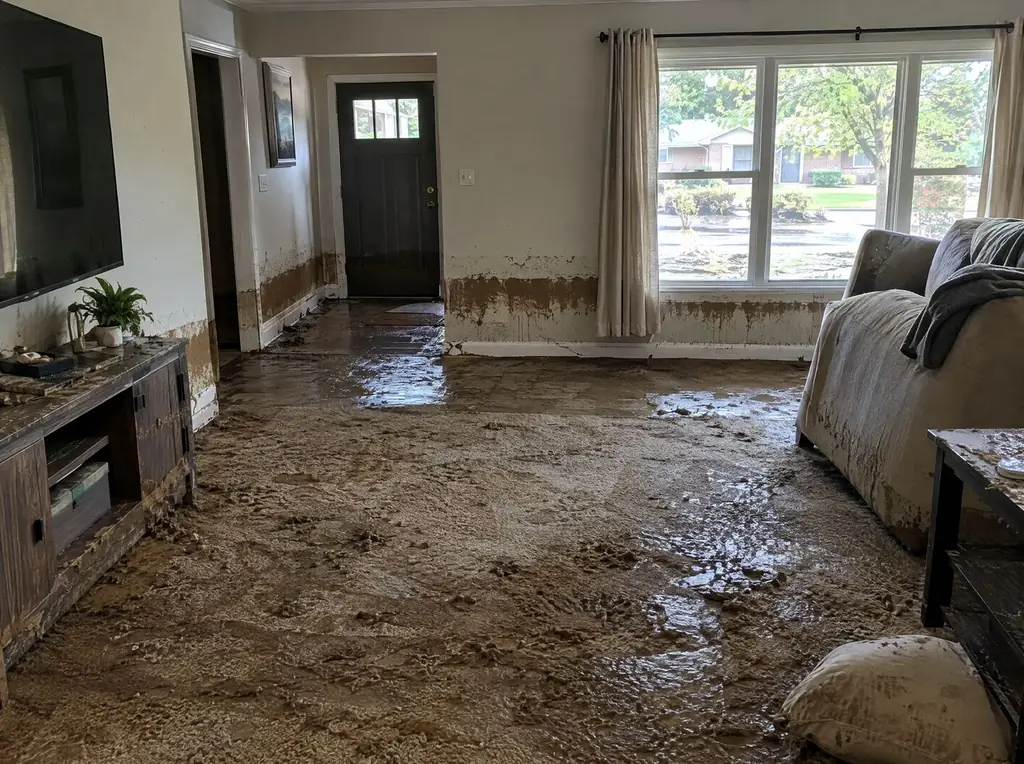
The National Weather Service's flood stages for Mill Creek at Woodbine name the streets that flood first, and FEMA's flood claims show which Nashville ZIP codes have taken the most water over the years. Both are on this site, updated with every rebuild.
Right now
- 1Stay out of standing water that could reach an outlet, an extension cord or the furnace; switch the power off only from a dry spot.
- 2Keep children and pets away from the water and wash with soap after any contact.
- 3Take dated photos of the high-water line on the walls and of every damaged room before anything is moved.
- 4Move what you can carry off the floor and out of the wet rooms.
- 5If water is still rising or a road is covered, leave and wait it out; don't drive or walk through moving water.
Nashville facts for this problem
NWS Nashville measured 13.57 inches at the airport over May 1 and 2, 2010, more than double the previous two-day record of 6.68 inches from September 1979.
Source: NWS Nashville: May 2010 Flood.
Mill Creek at Woodbine crested at a record 21.77 feet on May 1, 2010; at 15 feet, homes along Drummond Drive and a mobile home park on Philfre Court start to flood.
In March 2021, 7 to 9 inches fell on southeastern Davidson County and Sevenmile Creek reached 15.09 feet at Blackman Road, its highest on record.
Source: NWS Nashville: March 27-28, 2021 Major Flash Flooding.
Davidson County has been in the National Flood Insurance Program since 1982, and Metro bought 225 flood-damaged homes through a voluntary program after the 2010 flood.
Source: Metro Water Services: Flood Insurance Fact Sheet (2017).
FEMA lists 3,727 NFIP flood claims in the 20 Nashville ZIP codes on this site, with $144,487,437 paid on buildings and contents.
Source: FEMA OpenFEMA NFIP Redacted Claims v3, calculated by Nashville Water Damage & Mold on November 14, 2026.
2010 has the most NFIP claims by year of loss in those ZIPs, 1,697, ahead of 2021 with 441.
Source: FEMA OpenFEMA NFIP Redacted Claims v3, calculated by Nashville Water Damage & Mold on November 14, 2026.
About 1.2% of the homes in these Nashville ZIPs had a residential NFIP flood policy in force on September 1, 2026.
Source: FEMA OpenFEMA NFIP Redacted Policies v3, calculated by Nashville Water Damage & Mold on November 14, 2026.
Davidson County has been in the National Flood Insurance Program since 1982, so every homeowner and renter in the county can buy a flood policy. Metro Water Services' 2017 fact sheet put Metro at Class 8 in FEMA's Community Rating System, which lowers NFIP premiums by 10 percent, and noted that most home policies don't cover flood.
Sources: Metro Water Services: Flood Insurance Fact Sheet (2017)
Related on this site: the Nashville flooding history for every heavy rain day since 1871 with its rank, and the Nashville flood risk by ZIP for flood claims and NFIP policies ZIP by ZIP.
How the work usually goes
Safety and water out
Power is checked, standing water is pumped or extracted, and the mud left behind is shoveled and squeegeed out.
Your part: Point out where the outlets and the main breaker are.
Flood cuts
Wet drywall and insulation are cut out a set distance above the high-water line, and soaked carpet and pad are removed.
Your part: Photograph the wall before and after the cut.
Cleaning and disinfecting
Studs, slab, subfloor and crawl space surfaces are cleaned and treated because the water was contaminated.
Your part: Ask what was used on each surface.
Drying
Air movers and dehumidifiers usually run until every material reads dry, crawl space included; the IICRC worksheet sets how many air movers.
Your part: Leave the equipment running day and night.
Records
Moisture logs, photos and an itemized estimate should reach you before rebuilding starts.
Your part: Ask for them in writing and keep them together with the flood date.
How insurance usually treats it
Tennessee's insurance department says flood damage is not part of a standard homeowners policy; it takes a separate flood policy, mostly through the National Flood Insurance Program, and those policies usually start after a 30-day wait. Davidson County has been in the NFIP since 1982, so every homeowner and renter in the county can buy one.
This explains coverage in general and isn't insurance advice; your own policy has the final word. More on the Nashville water damage insurance page.
What changes the size of the job
- How high the water rose on the walls, which sets how much drywall and insulation comes out
- Whether the crawl space or a basement took water as well as the living space
- How much mud and debris has to be removed before drying can start
- How many rooms and how much flooring were under water
- How many drying days and pieces of equipment the job needs
No prices on this site. A company measures moisture on site and writes an itemized estimate; the water damage estimator lists what that estimate should include.
Questions people ask about flood cleanup
Which Nashville creeks flood homes?
NWS Nashville's 2021 flood page lists record or near-record rises on Sevenmile Creek, Browns Creek, Mill Creek and Richland Creek. At 15 feet on the Mill Creek gauge at Woodbine, homes on Drummond Drive and a mobile home park off Murfreesboro Pike start to flood.
Is flood damage covered by homeowners insurance in Tennessee?
Not by a standard policy, according to the Tennessee Department of Commerce and Insurance. Flood takes a separate policy, usually through the National Flood Insurance Program, and NFIP policies usually take effect after a 30-day wait.
How many homes did Metro buy out after the 2010 flood?
Metro Water Services says it had bought about 100 flood-damaged homes with FEMA grants before May 2010 and acquired 225 more afterward through a voluntary program.
Sources for this page
- NWS Nashville: May 2010 Flood
- NWS Nashville: March 27-28, 2021 Major Flash Flooding
- NWS National Water Prediction Service: Mill Creek at Woodbine (WBNT1)
- Metro Water Services: Flood Insurance Fact Sheet (2017)
- Tennessee Commerce and Insurance: Focus on Homeowners' Insurance guide
- Tennessee Department of Commerce and Insurance: flood insurance FAQs on the 10th anniversary of the Nashville flood (May 1, 2020)
- IICRC Airmover and Gallons Calculation Worksheet (rev. 7.1.22)